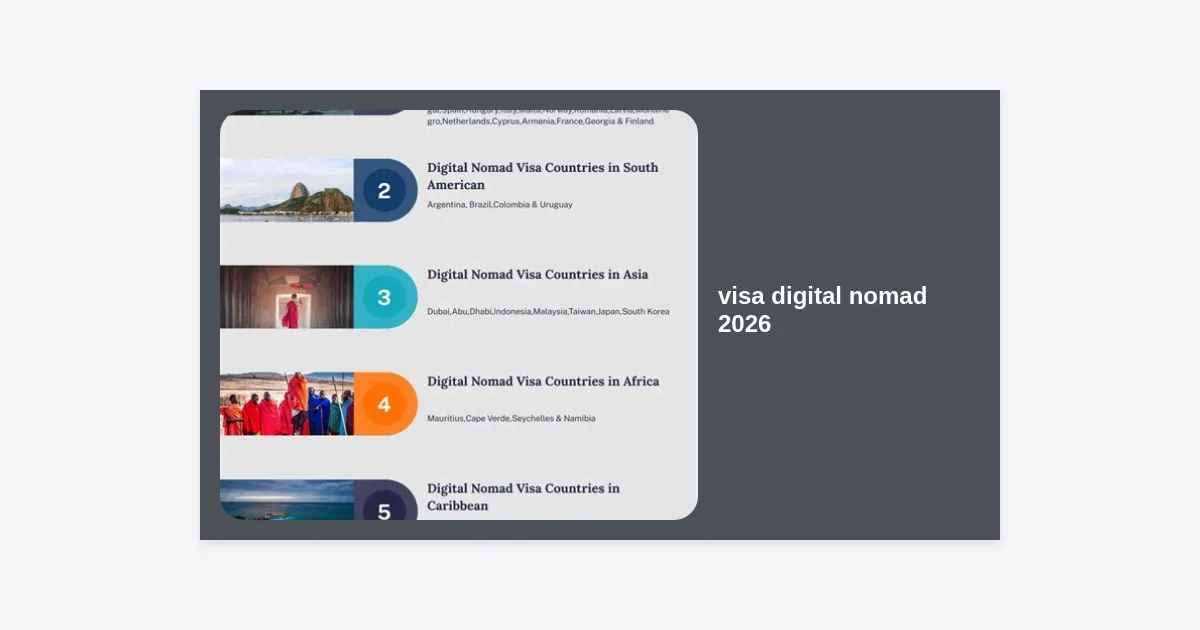
The dream of trading a cubicle for a beachfront café in Bali or a historic apartment in Lisbon is no longer just a post-pandemic fantasy. As we look toward the visa digital nomad 2026 landscape, the options for remote workers have expanded from a handful of experimental programs to a global infrastructure of long-term stays. For many, the challenge is no longer finding a country that will take them, but choosing the right one among dozens of competing offers. This guide explores the evolving world of remote work permits, helping you navigate the complexities of international residency in the coming year.
Table of Contents
- The Evolution of Remote Work: Why 2026 is Different
- Top Visa Digital Nomad 2026 Destinations
- European Leaders: Spain, Italy, and Portugal
- Asia-Pacific: The New Frontier in 2026
- Latin America: Cost-Effective and Culture-Rich
- Understanding Income Thresholds and Financial Proof
- Navigating Taxes and Social Security in 2026
- Step-by-Step Application Roadmap
- Free Resources and Checklists
- Final Thoughts: Your Next Steps
The Evolution of Remote Work: Why 2026 is Different
By 2026, the digital nomad visa market has reached maturity. In the early 2020s, countries were scrambling to recover lost tourism revenue by inviting remote workers. Today, the focus has shifted toward sustainable integration and attracting high-value talent that contributes to local economies without inflating housing markets.
Governments have refined their laws, making the visa digital nomad 2026 experience more streamlined but also more regulated. We are seeing a move away from simple 6-month permits toward multi-year residencies that offer paths to permanent stay. This maturity means more clarity on tax obligations and better infrastructure for the “anywhere office.”
“The digital nomad of 2026 is not just a traveler; they are a temporary resident who balances global income with local impact. Legal frameworks now reflect this dual identity.”
Top Visa Digital Nomad 2026 Destinations
Choosing a destination involves balancing lifestyle preferences with bureaucratic reality. While over 60 countries now offer specific visas for remote workers, a few stand out in 2026 for their accessibility and perks. Whether you seek the high-speed internet of Tokyo or the slow-paced life of the Algarve, there is a program designed for your needs.
Recent data suggests that the average digital nomad remains in one location for approximately 6 to 9 months. To accommodate this, many 2026 visas now offer a “1+2” structure: one year initially, followed by a two-year renewal. This provides the stability needed to truly immerse oneself in a foreign culture while maintaining a global career.
European Leaders: Spain, Italy, and Portugal
Europe remains the most sought-after region for the visa digital nomad 2026. Spain and Italy have recently updated their regulations to simplify the process for non-EU citizens. Spain’s remote work visa (integrated into its Startup Law) has become a gold standard, offering a unique tax regime known as the “Beckham Law” which allows nomads to be taxed at a lower flat rate for five years.
Italy finally streamlined its long-awaited digital nomad visa in late 2024, making it a prime choice for 2026. Applicants must demonstrate “highly qualified” status, which usually implies a degree or significant proven experience in their field. Portugal, meanwhile, has moved away from its famous D7 for nomads, instead focusing on the Digital Nomad Visa (D8), which specifically targets those with foreign-sourced income above €3,280 per month.
Asia-Pacific: The New Frontier in 2026
Asia has undergone a massive shift. Japan’s 6-month digital nomad visa, which debuted in 2024, has been optimized by 2026 to allow for easier renewals and family inclusion. Thailand remains a powerhouse with its Destination Thailand Visa (DTV). This 5-year visa allows for multiple entries with stays up to 180 days at a time, making it one of the most flexible options in the world.
South Korea and Taiwan have also entered the fray, targeting tech workers specifically. The South Korean “Workation” visa combines work with cultural experiences, often including government-sponsored tours or Korean language classes. For those looking for 2026 stability, these countries offer world-class internet speeds and safety standards that are hard to beat.
Latin America: Cost-Effective and Culture-Rich
For those prioritizing cost of living, Latin America remains unbeatable. Mexico remains a favorite despite not having a specific “nomad” visa; its Temporary Resident visa serves the purpose perfectly for those earning around $2,600 USD monthly. Colombia and Costa Rica have refined their specialized nomad permits to be 100% digital in application, with approvals often granted within 15 to 30 days.
Costa Rica’s 2026 program is particularly attractive for families, offering tax exemptions on imported equipment (like multiple monitors or specialty laptops) and the ability to drive using a foreign license for the duration of the visa. The lifestyle benefit—the “Pura Vida” mindset—is a significant draw for remote workers facing burnout in high-pressure Western environments.
Understanding Income Thresholds and Financial Proof
The most common hurdle for obtaining a visa digital nomad 2026 is the income requirement. Each country sets a minimum monthly income threshold to ensure that residents can support themselves without seeking local employment. In 2026, we see a broad spectrum of requirements:
- High-End: Japan, Iceland, and the UAE ($3,500 – $5,000+ per month).
- Mid-Range: Spain, Portugal, and Malta ($2,800 – $3,500 per month).
- Accessible: Colombia, Ecuador, and Malaysia ($1,500 – $2,500 per month).
When applying, you will need more than just pay stubs. Most consulates now require 6 to 12 months of bank statements, a valid contract with a company outside the host country, and often a “letter of intent” explaining your work situation. Precision in these documents is key to avoiding rejection.
Navigating Taxes and Social Security in 2026
One of the most misunderstood aspects of the visa digital nomad 2026 is tax residency. Most countries consider you a tax resident if you spend more than 183 days in their territory. However, some nomad visas offer specific exemptions to prevent double taxation.
For example, Malaysia’s DE Rantau program and the Thai DTV have created specific rules that allow nomads to avoid paying local income tax on money earned from foreign clients, provided it isn’t brought into the country in the same year it’s earned (in Thailand’s case). Always consult with a specialized cross-border tax advisor to understand how your home country’s tax treaties interact with your host country’s laws.
Step-by-Step Application Roadmap
While every country has its quirks, the general process for securing a visa digital nomad 2026 follows a standard path. Preparation is roughly 70% of the work. Follow these steps to ensure a smooth transition:
- Eligibility Check: Confirm your income meets the threshold and your employer permits working from the specific country.
- Document Gathering: Collect your passport (valid for at least 12-18 months), criminal record checks (apostilled), and health insurance with global coverage.
- Apostille and Translation: Most non-English speaking countries require your documents to be translated and legalized via an Apostille stamp.
- Health Insurance: Ensure your policy specifically mentions “repatriation” and has high coverage limits, as this is a frequent cause for visa denial.
- Submission: Many countries now use dedicated online portals, though some European nations still require an in-person appointment at a consulate.
Free Resources and Checklists
To help you prepare for your move, we have compiled a comprehensive planning sheet that covers everything from tax preparation to finding a community. Whether you are a solo freelancer or a corporate employee, being organized is the best way to reduce stress.
Download Digital Nomad Planning Checklist 2026
Final Thoughts: Your Next Steps
The visa digital nomad 2026 market is designed to empower you with choice. While the bureaucracy can feel daunting, the reward is the ability to design your life around your experiences rather than your commute. In 2026, the world is more accessible than ever for those with the skills to work anywhere.
Key Takeaways:
- Start Early: Begin your document gathering at least three months before your planned departure.
- Verify Income: Ensure your bank statements clearly show consistent deposits over the last year.
- Community Matters: Choose a destination with a strong co-working infrastructure if you value social interaction.
- Stay Legal: Always enter on the correct visa; working on a tourist visa is becoming increasingly risky as border systems become more digitized.
Research your top three destinations today, compare their income requirements, and take the first step toward your global office. The future of work is not a place—it is a choice.