The Rise of the Connected World
The world is no longer just a collection of isolated devices; it is a living, breathing network of data. For a visionary iot investor, this transformation represents one of the most significant wealth-creation opportunities of the 21st century. From smart refrigerators in modern kitchens to predictive sensors on factory floors, the Internet of Things (IoT) is fundamentally altering how we live and work.
Investing in this space requires more than just capital. It requires a deep understanding of hardware, software, and the connectivity layers that bind them. Whether you are a venture capitalist or an individual iot investor, staying ahead of the curve means identifying the companies that solve real-world problems through seamless connectivity.
This guide serves as a comprehensive roadmap for anyone looking to navigate the complex world of IoT investments. We will explore the market dynamics, technical requirements, and the specific strategies that successful investors use to mitigate risk and maximize returns in the connected economy.
Why Become an IoT Investor Today?
The numbers behind the IoT market are staggering. According to recent industry reports, the global IoT market size is projected to grow from hundreds of billions to several trillion dollars by 2030. This growth is driven by the decreasing cost of sensors, the proliferation of high-speed 5G networks, and an urgent need for operational efficiency across all industries.
As an iot investor, you are not just betting on gadgets. You are betting on the infrastructure of the future. The integration of IoT with Artificial Intelligence (AI) and Machine Learning (ML) has created a new category known as AIoT, which is unlocking value in data that was previously ignored.
“The Internet of Things is not a market; it is a transition of the entire global economy toward a more data-driven, efficient, and interconnected state.”
Furthermore, ESG (Environmental, Social, and Governance) goals are pushing corporations to adopt IoT solutions. Smart grids, efficient water management systems, and precision agriculture all rely on IoT to reduce waste and carbon footprints. This alignment with global sustainability goals makes the role of an iot investor even more critical and potentially lucrative.
Top Sectors for IoT Investment
When searching for the next big breakthrough, an iot investor must look at sectors where connectivity provides the highest ROI. Here are the primary areas currently attracting significant capital:
Industrial IoT (IIoT) and Industry 4.0
Manufacturing is perhaps the most mature sector for IoT. Predictive maintenance allows factories to identify when a machine is likely to fail before it actually happens, saving millions in downtime. For an iot investor, IIoT companies with strong proprietary algorithms for data analysis are highly attractive.
Smart Cities and Infrastructure
Governments are investing heavily in smart infrastructure. This includes intelligent traffic management, automated street lighting, and waste management sensors. These projects often involve long-term contracts, providing a stable exit strategy for the patient iot investor.
Connected Health (IoMT)
The Internet of Medical Things (IoMT) is revolutonizing patient care. Wearable devices that monitor heart rates, glucose levels, and sleep patterns allow for remote patient monitoring. Investors are flocking to startups that secure patient data while providing actionable medical insights.
- Agriculture: Precision farming using soil sensors and drone imagery.
- Logistics: Real-time asset tracking across global supply chains.
- Retail: Smart inventory management and personalized customer experiences.
- Energy: Smart meters and decentralized energy grid management.
Technical Due Diligence for the IoT Investor
Investing in software is hard; investing in IoT is harder because it involves “the atoms and the bits.” A savvy iot investor must perform rigorous technical due diligence to ensure a company can scale. Unlike pure software, hardware has manufacturing cycles, supply chain dependencies, and physical failure points.
One of the first things an iot investor should examine is the “Connectivity Stack.” Does the device use Wi-Fi, Bluetooth, LoRaWAN, or 5G? Each has different power requirements and range limitations. If a company is using the wrong protocol for its use case, it will struggle to achieve market fit.
Security is the other major pillar. Many early IoT devices were notorious for being easily hackable. Today, an iot investor must demand end-to-end encryption, secure boot processes, and a clear plan for over-the-air (OTA) updates. A single security breach can destroy a brand’s reputation and an investor’s capital overnight.
How to Find and Attract an IoT Investor
If you are a founder, finding the right iot investor is about finding a partner who understands the long game. Because hardware takes longer to prototype and ship than software, you need investors with “patient capital.”
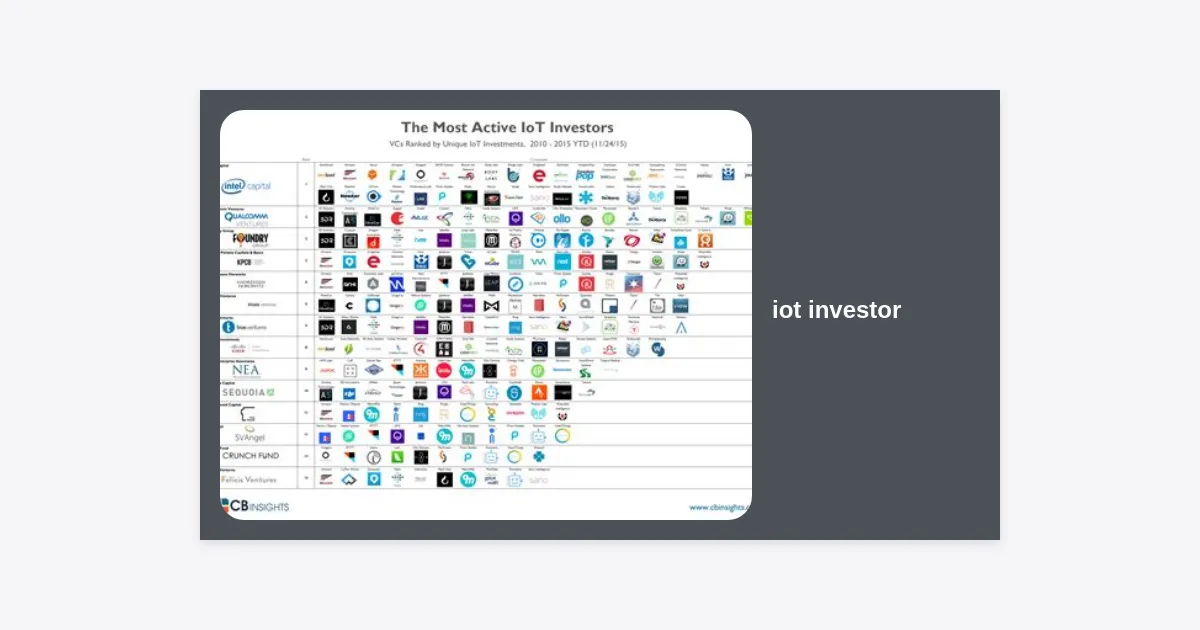
Look for venture capital firms that have dedicated hardware or deep-tech funds. Notable names in the space often include Intel Capital, Qualcomm Ventures, and specialized firms like McRock Capital or Bolt. Engaging with these firms requires a prototype that demonstrates “Proof of Value,” not just “Proof of Concept.”
Networking at major industry events like CES (Consumer Electronics Show) or the IoT World Congress is essential. When pitching to an iot investor, focus on the problem you are solving and the data you are collecting, rather than just the physical device. The data is often where the long-term value lies.
Winning Business Models in IoT
The most successful companies backed by an iot investor typically move away from one-time hardware sales. Instead, they embrace recurring revenue models. Here are the most effective strategies:
- Hardware-as-a-Service (HaaS): Customers pay a monthly fee for the use of the device and the associated data insights.
- Data Monetization: Selling anonymized, aggregated data to third parties (e.g., traffic data to urban planners).
- Consumables Replenishment: Devices that automatically order supplies when they run low (e.g., smart printers or coffee machines).
- Premium Software Features: Offering core functionality for free while charging for advanced analytics or security features.
For an iot investor, these models are preferred because they create high switching costs and predictable cash flows, making the company much more valuable at exit.
Risks and Challenges to Consider
No investment is without risk, and the IoT space has several unique hurdles. Fragmentation is a major issue; there are too many competing standards and protocols, which can prevent devices from talking to each other. An iot investor must be wary of companies that build “walled gardens” that don’t play well with others.
Supply chain volatility is another factor. The global chip shortage of recent years proved how vulnerable hardware startups are to external shocks. A prepared iot investor will ask about a startup’s manufacturing partnerships and their ability to source components from multiple vendors.
Regulatory compliance is also becoming more complex. With laws like the GDPR in Europe and the CCPA in California, how IoT companies handle personal data is under the microscope. An iot investor must ensure that their portfolio companies are compliant with international data privacy laws from day one.
Future Trends: 5G, AI, and Edge Computing
Where is the smart money going next? The experienced iot investor is currently looking at Edge Computing. This technology allows data to be processed locally on the device rather than being sent to a distant cloud server. This reduces latency and bandwidth costs, which is crucial for autonomous vehicles and industrial robotics.
The roll-out of 5G is another massive tailwind. 5G allows for a much higher density of connected devices per square kilometer, enabling the true vision of “Massive IoT.” For the iot investor, this opens up opportunities in areas that were previously technically impossible due to connectivity bottlenecks.
Finally, the integration of generative AI into IoT interfaces is a burgeoning trend. Imagine talking to your home or factory and having it respond with complex data analysis in natural language. This level of interaction will drive mass adoption, and the iot investor who identifies the platforms facilitating this will see significant gains.
Final Thoughts: The Path Forward
Becoming a successful iot investor requires a blend of technical curiosity and financial discipline. The space is moving fast, and the distinction between “cool gadgets” and “essential infrastructure” is where the best profits are found. By focusing on sectors with high friction, looking for recurring revenue models, and insisting on robust security, you can build a resilient and high-performing IoT portfolio.
The next decade will see billions of new devices come online. Whether these devices power our cities, heal our bodies, or optimize our industries, they will all need the strategic support of a knowledgeable iot investor. Now is the time to deepen your expertise and start identifying the leaders of the ultra-connected future.
Key Takeaways:
- Industrial IoT remains the most profitable sector due to massive efficiency gains.
- Security and scalability are the non-negotiables in technical due diligence.
- Recurring revenue via HaaS is the gold standard for business models.
- Keep an eye on Edge Computing and 5G as primary growth drivers.