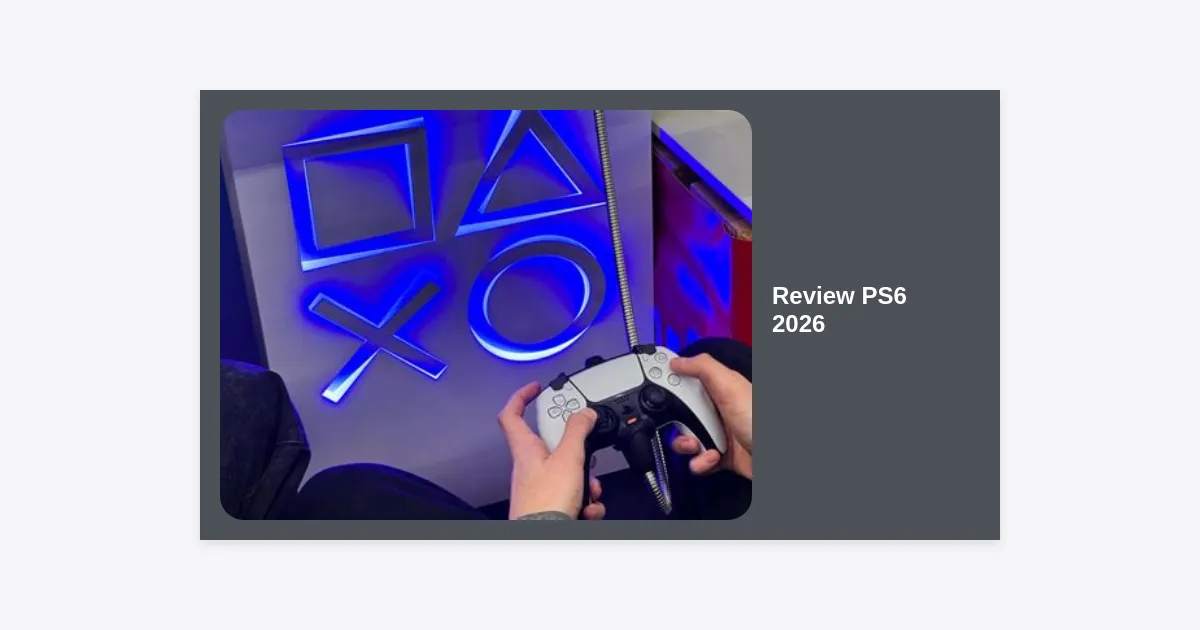
As we approach the mid-point of this decade, the gaming world is buzzing with anticipation for what Sony has in store. If you are looking for a comprehensive Review PS6 2026, you have come to the right place. While the PlayStation 5 continues to dominate the market with its impressive library and hardware revisions, the horizon is already glowing with the promise of the PlayStation 6. In this detailed analysis, we dive deep into the rumors, hardware leaks, and industry projections to see if the next generation will truly redefine our interactive entertainment experience.
Table of Contents
- The Next Era of Gaming: Why the Hype is Real
- Release Date Speculations: Why 2026 is the Critical Year
- Hardware and Performance: Under the PS6 Hood
- Ray Tracing and AI: The PSSR Revolution
- The DualSense Successor: Immersive Feedback 2.0
- Backward Compatibility: Preserving Your Digital Library
- Anticipated Launch Titles: What Will We Play?
- Pricing Strategy: The Real Cost of Next-Gen
- Final Verdict: Is the PS6 Worth the Wait?
The Next Era of Gaming: Why the Hype is Real
Gaming has evolved from simple pixels to photorealistic landscapes that blur the line between cinema and interactivity. When we look at a Review PS6 2026 perspective, we aren’t just talking about slightly better shadows or faster loading times. We are talking about a fundamental shift in how games are processed and delivered.
Sony has historically followed a 6-to-7-year cycle for its console generations. With the PS5 launching in 2020, the mid-to-late 2020s represent the traditional window for a successor. The demand for more complex AI, seamless open worlds, and 8K fidelity is pushing current hardware to its limits, necessitating a leap in architecture.
Release Date Speculations: Why 2026 is the Critical Year
Industry insiders and supply chain analysts have been pointing toward a specific window. While some suggest a 2027 release, our Review PS6 2026 analysis suggests that a late 2026 unveiling could be Sony’s strategy to stay ahead of the curve. This would align with AMD’s roadmap for next-gen chipsets and the increasing saturation of 4K/120Hz displays in average households.
Why does 2026 matter? By this time, the “cross-gen” period of the PS5 will be long over. Developers will be hungry for hardware that doesn’t hold back their creative visions. Research from market analysts suggests that console lifecycles are slightly accelerating as digital distribution matures, making 2026 a prime candidate for the next big jump.
Hardware and Performance: Under the PS6 Hood
If we are to conduct a hypothetical Review PS6 2026, we must look at the silicon. Reliable leaks suggest Sony is once again partnering with AMD. The heart of the PS6 is expected to be a custom chip leveraging the Zen 5 or Zen 6 CPU architecture and RDNA 4 or 5 GPU technology.
Here are the projected specifications based on current industry trends:
- CPU: 16-core AMD Zen 5/6 processor for advanced physics and NPC logic.
- GPU: Custom RDNA solution capable of 30+ Teraflops of compute power.
- Memory: 32GB of GDDR7 RAM to handle massive asset streaming.
- Storage: 2TB or 4TB NVMe Gen 5 SSD with speeds exceeding 10GB/s.
This leap in power isn’t just for show. A Review PS6 2026 would highlight how these specs eliminate the “invisible walls” and loading screens that still linger in current-gen titles. We are looking at a machine designed for pure, unadulterated performance.
Ray Tracing and AI: The PSSR Revolution
One of the most exciting aspects of our Review PS6 2026 coverage is the evolution of PSSR (PlayStation Spectral Super Resolution). Similar to NVIDIA’s DLSS, this AI-driven upscaling will allow the PS6 to render games at lower internal resolutions while outputting a crisp 4K or even 8K image at high frame rates.
Real-time ray tracing will no longer be a “toggle” that drops your frame rate to 30 FPS. The PS6 aims to deliver path-traced visuals at a stable 60 or 120 FPS. This means lighting, reflections, and global illumination will behave exactly as they do in the real world, providing an unprecedented level of immersion.
“The future of console gaming isn’t just about raw horsepower; it’s about how intelligently that power is used to create realistic environments through AI and machine learning.” – Lead Systems Architect (Speculative)
The DualSense Successor: Immersive Feedback 2.0
The PS5 brought us haptic feedback and adaptive triggers. What does the Review PS6 2026 tell us about the future of the controller? Patented designs suggest Sony is experimenting with temperature-shifting materials and even more precise actuators.
Imagine your controller getting cold when your character enters a blizzard or feeling the subtle heat of an engine through the grips. Additionally, improved battery life—a common complaint with the current DualSense—is a top priority for the next iteration. The goal is to make the controller an extension of the player’s senses.
Backward Compatibility: Preserving Your Digital Library
One critical area for any Review PS6 2026 is the transition of your current games. Sony has learned from the PS3-to-PS4 transition error. It is highly expected that the PS6 will be fully backward compatible with PS5 titles, and potentially even PS4 titles.
Furthermore, expect “PS6 Enhanced” patches for current-generation hits like God of War Ragnarök and Horizon Forbidden West. This ensures that the day you buy your new console, you already have a library of hundreds of games that look and play better than ever before.
Anticipated Launch Titles: What Will We Play?
A console is only as good as its games. While we don’t have a confirmed list, the Review PS6 2026 outlook suggests several heavy hitters are in early development for the next hardware cycle. We can expect sequels to established franchises and groundbreaking new IPs.
- The Last of Us Part III: Naughty Dog’s potential swan song for the new hardware.
- A New IP from Santa Monica Studio: Rumored to be a sci-fi epic.
- Marvel’s Spider-Man 3: Taking the scale of NYC to a whole new level.
- Horizon 3: The conclusion to Aloy’s journey with full path-traced graphics.
Third-party publishers like Rockstar, Ubisoft, and EA will also be ready. Whether it’s the next Grand Theft Auto expansion or a revitalized Call of Duty engine, the PS6 will be the premier place to play these blockbuster titles.
Pricing Strategy: The Real Cost of Next-Gen
How much will this leap forward cost you? Based on our Review PS6 2026 market analysis, we expect a starting price point of $499 to $599. With the rising costs of components and manufacturing, a sub-$500 price point for a machine of this caliber seems unlikely.
Sony may continue its strategy of offering a “Digital Edition” and a standard edition with a disc drive. However, as the world moves closer to a fully digital future, the disc drive might become an optional modular peripheral, much like the recent PS5 Slim design.
Comparison: PS5 Pro vs. PS6
Many gamers wonder if they should buy a PS5 Pro now or wait for the PS6. If you want the best possible experience today, the PS5 Pro is a fantastic mid-gen upgrade. However, if you can hold out for another 18-24 months, the PS6 represents a true generational shift rather than just an incremental boost.
Final Verdict: Is the PS6 Worth the Wait?
In conclusion, our Review PS6 2026 indicates that Sony is preparing a masterclass in gaming technology. By combining raw hardware strength with sophisticated AI upscaling and refined immersive features, the PS6 is poised to be the gold standard for the late 2020s.
Key Takeaways:
- Performance: Expect 4K/120FPS as a standard, with 8K possibilities.
- AI Integration: PSSR will be a game-changer for visual fidelity.
- Ecosystem: Strong backward compatibility will protect your current investments.
- Timeline: Target late 2026 for the first official major announcements.
If you are a hardcore gamer, the PS6 is definitely worth keeping an eye on. As more leaks emerge, we will update this Review PS6 2026 to reflect the most accurate data. Stay tuned to the evolution of play!