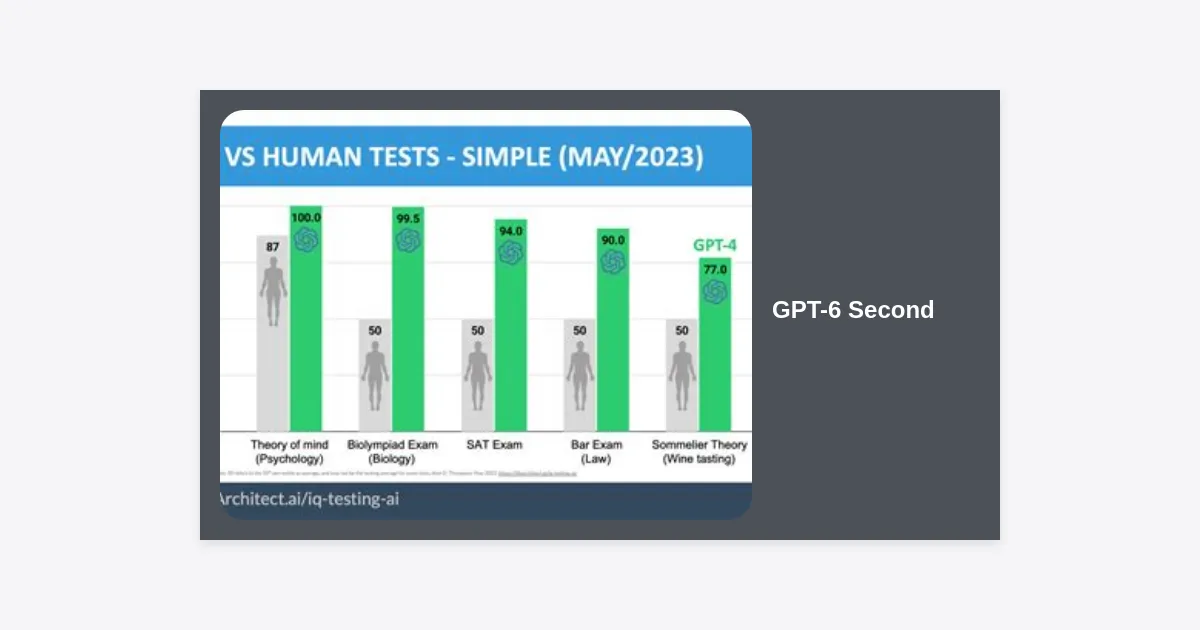
The artificial intelligence landscape is moving at a breakneck pace, leaving many to wonder what the next leap forward looks like. While the world is still mastering GPT-4 and anticipating GPT-5, the term GPT-6 Second has begun to surface among researchers and tech enthusiasts. This concept represents more than just a version number; it signifies a fundamental shift in how AI processes information per second and how iterative intelligence will redefine human-computer interaction. If you are looking to understand the next frontier of generative models, you are in the right place.
- What is GPT-6 Second? Defining the Next Era
- The Speed of Thought: Why “Second” Matters in AI
- Key Features and Predicted Capabilities
- Comparing the Generations: GPT-5 vs. GPT-6 Second
- Impact on Global Industries
- Ethical Considerations and AI Safety
- How to Prepare for the GPT-6 Era
- Conclusion: The Road Ahead
What is GPT-6 Second? Defining the Next Era
To understand GPT-6 Second, we must first look at the trajectory of Large Language Models (LLMs). Traditionally, AI development focused on scale—more parameters, more data, and more compute power. However, as we approach the physical limits of data centers, the focus is shifting toward efficiency and “System 2” thinking.
The term “GPT-6 Second” refers to a theoretical framework where the AI doesn’t just predict the next token, but processes complex reasoning cycles in a fraction of a second. It represents the “second” iteration of the sixth-generation architecture, optimized for real-time agentic workflows. This isn’t just a chatbot; it is a reasoning engine capable of autonomous decision-making.
In this context, GPT-6 Second acts as a bridge between static artificial intelligence and proactive digital agents. It implies a model that can think, verify its own logic, and correct errors before the user even sees the output. This “inner monologue” occurs in the seconds between a prompt and a response, ensuring unprecedented accuracy.
The Speed of Thought: Why “Second” Matters in AI
In the world of AI, latency is the enemy of adoption. For an AI to truly feel like a human collaborator, it must respond within the window of human conversation—usually under a second. GPT-6 Second represents the milestone where massive reasoning capabilities meet sub-second response times.
Why is this important? Consider the following use cases where timing is critical:
- Autonomous Surgery: A fraction of a second can determine the success of a robotic surgical procedure guided by AI.
- Financial Trading: High-frequency trading algorithms requiring AI reasoning need to act in milliseconds to capitalize on market shifts.
- Real-time Translation: For a natural conversation between two people speaking different languages, the AI must translate within a “GPT-6 Second” window to maintain flow.
- Emergency Response: AI-driven dispatchers must analyze incoming data and provide life-saving instructions instantly.
By optimizing the inference speed, GPT-6 Second enables these high-stakes applications to move from science fiction to reality. The focus moves from “What can the AI know?” to “How fast can the AI act?”
Key Features and Predicted Capabilities
While official specifications for a sixth-generation model are still speculative, industry trends allow us to predict the core features of GPT-6 Second with high confidence. Based on current research in agentic AI and neural architecture, we can expect the following:
1. Native Multimodality
Unlike previous models that “stitched” together vision, voice, and text, GPT-6 Second will likely be natively multimodal from day one. This means it processes video, audio, and text in a single unified latent space, allowing it to “see” and “hear” the world with the same nuance as a human.
2. System 2 Reasoning
Drawing from the “Thinking, Fast and Slow” framework, GPT-6 Second will incorporate slow, deliberate reasoning. It won’t just guess the next word; it will run internal simulations to verify its answers. This drastically reduces hallucinations, a major pain point for current LLM users.
3. Long-Term Memory and Personalization
One of the biggest hurdles today is the context window. GPT-6 Second is expected to feature persistent memory, allowing it to remember interactions from months ago, effectively becoming a personalized digital twin that grows with the user.
“The goal of GPT-6 Second is not just to provide an answer, but to provide the *correct* answer through iterative self-correction and deep contextual understanding.”
Comparing the Generations: GPT-5 vs. GPT-6 Second
To visualize the leap in technology, let’s look at how the different generations of GPT models compare in terms of their core architecture and utility.
| Feature | GPT-4 / GPT-4o | GPT-5 (Predicted) | GPT-6 Second |
|---|---|---|---|
| Primary Goal | Conversational Fluency | Reasoning & Reliability | Autonomous Agency |
| Latency | 1-3 Seconds | Sub-second (Small tasks) | Near-Instant / Real-time |
| Reasoning | Pattern Matching | Basic Logic Steps | Recursive Self-Correction |
| Autonomy | Limited Tool Use | Task-focused Agents | Independent Goal-Setting |
As the table illustrates, GPT-6 Second moves us into the realm of independent goal-setting. It doesn’t just follow instructions; it anticipates needs and executes complex, multi-step projects with minimal human intervention.
Impact on Global Industries
The arrival of GPT-6 Second will send shockwaves through every sector of the global economy. When AI can think and act in real-time, the value proposition of traditional software changes.
Software Development and Coding
In the era of GPT-6 Second, coding becomes a matter of high-level architecture. The AI will handle the syntax, debugging, and deployment in seconds. We are moving toward a “Natural Language Programming” world where the time between an idea and a functional application is practically zero.
Healthcare and Diagnostics
With its ability to process vast amounts of medical literature and patient data in a GPT-6 Second, AI will become the ultimate diagnostic assistant. It will identify patterns in genomic data that would take humans years to find, potentially leading to cures for rare diseases through real-time molecular modeling.
Education and Personalized Learning
Imagine a tutor that knows exactly where a student is struggling and can rewrite an entire curriculum in a second to match that student’s learning style. GPT-6 Second makes hyper-personalized education at scale possible, lowering the barrier to mastery for millions of people.
Ethical Considerations and AI Safety
As we approach the power of GPT-6 Second, the risks increase alongside the rewards. Authoritative AI requires authoritative safety measures. The speed at which these models operate means that human oversight must be integrated into the architecture itself.
- Alignment: Ensuring the AI’s goals remain aligned with human values even as it operates autonomously.
- Job Displacement: As AI takes over complex reasoning tasks, the workforce must pivot to roles that require empathy and human-centric judgment.
- Data Privacy: With persistent memory, the amount of personal data GPT-6 Second will handle is immense, requiring new standards in encryption and decentralized AI.
Developers are currently working on “Constitutional AI” and circuit-breaker mechanisms to ensure that a GPT-6 Second response remains safe and beneficial, regardless of the prompt complexity.
How to Prepare for the GPT-6 Era
You don’t need to wait for the official release to start preparing for the world of GPT-6 Second. The shift toward agentic AI is already happening. Here is actionable advice to stay ahead:
- Master Prompt Engineering: Learn to communicate in “objectives” rather than just “tasks.” The next generation of AI will respond best to high-level goals.
- Adopt AI Workflows Early: Integrate current tools like ChatGPT Plus or Claude into your daily routine to understand the limitations and strengths of LLMs.
- Focus on Soft Skills: As technical tasks become automated, human skills like leadership, emotional intelligence, and strategic thinking become your competitive advantage.
- Stay Informed: Follow reputable AI research labs and tech news to track the evolution of GPT-6 Second and its rollout.
Conclusion: The Road Ahead
The journey toward GPT-6 Second represents the most significant technological leap in our lifetime. We are moving from a world where we use digital tools to a world where we collaborate with digital entities. This transition will be defined by speed, reasoning, and the ability of AI to act as a true partner in human progress.
By understanding the importance of sub-second reasoning and the shift toward autonomous agents, you can position yourself at the forefront of this revolution. The future isn’t just coming; it’s arriving in a GPT-6 Second. Are you ready?