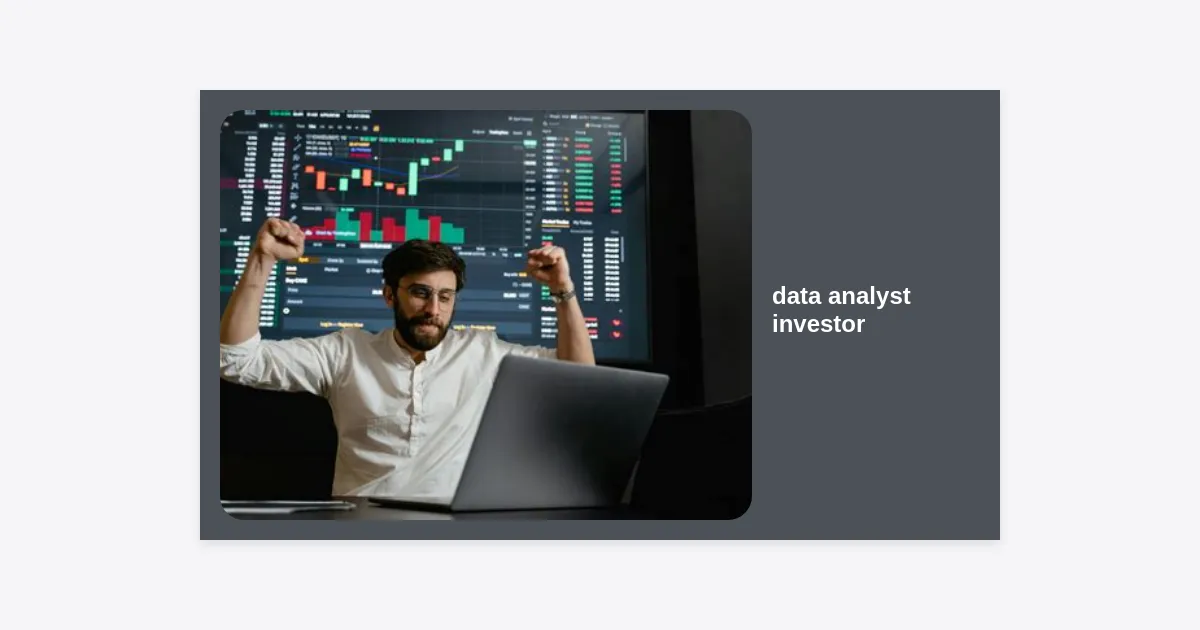
In today’s hyper-volatile financial landscape, the traditional “gut feeling” approach to picking stocks is rapidly becoming obsolete. Instead, a new breed of market participant is taking center stage: the data analyst investor. This hybrid professional combines the rigorous quantitative skills of a data scientist with the financial acumen of a seasoned portfolio manager. By leveraging algorithms, statistical modeling, and alternative data sets, the data analyst investor is able to find signals in noise where others only find confusion. If you’ve ever wondered how modern hedge funds consistently outperform the average retail trader, the answer lies in data processing and analysis.
- What is a Data Analyst Investor?
- The Data Advantage in Modern Markets
- Core Skills for the Data Analyst Investor
- Essential Tools and Technologies
- Types of Data to Analyze for Better ROI
- A Step-by-Step Data Analysis Framework
- Managing Risk Through Quantitative Methods
- Common Pitfalls to Avoid
- Conclusion: Your Future in Data-Driven Investing
What is a Data Analyst Investor?
A data analyst investor is an individual who makes investment decisions primarily based on empirical data rather than speculation or news-cycle hysteria. Unlike traditional fundamental analysts who might only look at quarterly reports, the data-driven investor builds systems to ingest thousands of data points simultaneously.
This role isn’t just about reading charts; it’s about understanding the underlying distributions of market returns. It involves identifying correlations that aren’t visible to the naked eye. For instance, a data analyst investor might correlate satellite imagery of retail parking lots with upcoming quarterly revenue projections. This level of insight provides a “near-real-time” view of an investment’s health long before the official numbers are released.
The Data Advantage in Modern Markets
Why is everyone talking about the data analyst investor now? The volume of data generated globally is growing exponentially. From social media sentiment to credit card transaction data, the information is there—but it is fragmented.
- Speed of Execution: Automated data scripts can process information in milliseconds, allowing you to react to news before it hits the mainstream media.
- Elimination of Bias: Humans are prone to cognitive biases like loss aversion and confirmation bias. A data-driven model doesn’t “feel” anything; it simply executes based on predefined parameters.
- Backtesting: One of the greatest weapons for a data analyst investor is the ability to backtest a strategy against 20 years of historical data to see how it would have performed during various economic cycles.
Core Skills for the Data Analyst Investor
Becoming an effective data analyst investor requires a multi-disciplinary approach. You cannot simply be a coder; you must also understand how markets function. Here are the foundational pillars you need to master:
1. Statistical Proficiency
You need a solid grasp of statistics beyond just averages. Understanding standard deviation, variance, p-values, and regression analysis is vital. These concepts help you determine if a stock’s recent price movement is a genuine trend or just statistical noise.
2. Programming (Python or R)
While Excel is great for basic calculations, Python has become the industry standard for the data analyst investor. Libraries like Pandas for data manipulation, NumPy for numerical computing, and Scikit-learn for predictive modeling are essential parts of the modern toolkit.
3. Financial Literacy
Data without context is dangerous. You must be able to read a balance sheet, understand cash flow statements, and grasp the nuances of macroeconomic indicators like inflation rates and bond yields. A data analyst investor knows that even the best model won’t work if it ignores fundamental economic realities.
Essential Tools and Technologies
To operate at a high level, you need the right software stack. These tools allow you to scrape data, store it, and visualize it for better decision-making.
| Category | Recommended Tools | Use Case |
|---|---|---|
| Data Sources | Yahoo Finance API, Quandl, Alpha Vantage | Retrieving historical price and volume data. |
| Data Processing | Python (Pandas), SQL | Cleaning and organizing large datasets. |
| Visualization | Tableau, Matplotlib, Plotly | Identifying visual trends and outliers. |
| Infrastructure | AWS, Google Cloud, Docker | Deploying automated trading or alert systems. |
Types of Data to Analyze for Better ROI
The modern data analyst investor doesn’t stop at price action. They look for alpha in non-traditional places. This is often referred to as “Alternative Data.”
Sentiment Analysis
By using Natural Language Processing (NLP), you can analyze thousands of tweets, Reddit posts, and news articles to gauge the public mood toward a specific company. A sudden spike in negative sentiment often precedes a price drop.
Supply Chain Data
Tracking shipping manifests and logistics data can tell you if a semiconductor company’s products are sitting in warehouses or moving to consumers. This leading indicator is a favorite for the institutional data analyst investor.
A Step-by-Step Data Analysis Framework
- Define the Hypothesis: Start with a question. For example, “Do tech stocks underperform when the 10-year Treasury yield rises above 4%?”
- Data Collection: Use an API to pull 10 years of yield data and 10 years of tech stock index data (like the QQQ).
- Data Cleaning: Remove any missing values or anomalies that might skew the results.
- Exploratory Data Analysis (EDA): Create scatter plots to visualize the relationship between the two variables.
- Modeling: Run a correlation analysis or a linear regression to see if the relationship is statistically significant.
- Validation: Test the model on a “hold-out” set of data to verify it still works outside of your initial sample.
Managing Risk Through Quantitative Methods
The most important job of a data analyst investor is not making money, but preserving capital. Data allows for much more sophisticated risk management than simple “stop-loss” orders.
“Risk comes from not knowing what you’re doing.” – Warren Buffett
By using Value at Risk (VaR) models, an investor can estimate the maximum potential loss over a specific timeframe with a certain level of confidence. Furthermore, a data analyst investor uses Monte Carlo simulations to run thousands of possible future scenarios to see how their portfolio stands up against extreme market volatility (black swan events).
Common Pitfalls to Avoid
Even with the best tools, it’s easy to make mistakes. As a data analyst investor, you must guard against the following:
- Overfitting: This happens when you create a model that is so perfectly tuned to historical data that it fails to predict anything in the future. It’s “memorizing” the past rather than learning from it.
- Survivorship Bias: If you only analyze companies that currently exist, you ignore all the ones that went bankrupt. This leads to overly optimistic projections.
- Ignoring Transaction Costs: A strategy might look great on paper, but if it requires trading 50 times a day, the fees and taxes will eat all your profits. A smart data analyst investor always factors in slippage and commissions.
Conclusion: Your Future in Data-Driven Investing
The transition from a traditional trader to a data analyst investor doesn’t happen overnight, but the rewards are significant. In an age where information is the most valuable commodity, the ability to process that information into actionable wisdom is the ultimate competitive advantage.
Start small: begin by automating a simple spreadsheet or learning the basics of Python. As you build your skills, you’ll find that the “chaos” of the stock market starts to look much more like a series of solvable equations. The market doesn’t care about your opinions, but it always leaves a trail of data. It’s time to follow it.
Key Takeaways:
- A data analyst investor uses quantitative evidence to remove emotion from trading.
- Python and SQL are the most critical technical skills to acquire.
- Risk management should be driven by statistical models like VaR and Monte Carlo simulations.
- Always beware of overfitting and survivorship bias in your models.