Table of Contents
- 1. Introduction to Web Digital Marketing
- 2. The Core Pillars of a Digital Strategy
- 3. Search Engine Optimization (SEO) for Maximum Visibility
- 4. Content Marketing: Building Authority and Trust
- 5. Paid Advertising (PPC): Driving Immediate Results
- 6. Social Media Marketing: Engaging Your Audience
- 7. Email Marketing and Automation
- 8. Measuring Success with Data Analytics
- 9. Future Trends in Web Digital Marketing
- 10. Conclusion and Next Steps
1. Introduction to Web Digital Marketing
In today’s hyper-connected world, businesses can no longer rely solely on traditional advertising to reach their audience. The modern consumer begins their journey online, making web digital marketing the most critical component of any successful business strategy. Whether you are a small local shop or a multinational corporation, your digital presence determines your ability to compete and scale.
But why is web digital marketing so complex? It’s because the digital landscape is constantly shifting, with search engine algorithms evolving daily and new social platforms emerging overnight. This guide is designed to cut through the noise, providing you with a comprehensive roadmap to navigate the complexities of online growth and build a brand that lasts.
According to recent industry data, over 93% of all online experiences begin with a search engine. If your business isn’t visible where people are looking, you are essentially invisible. This guide will teach you how to claim your space in the digital ecosystem, leveraging data-driven strategies to convert casual browsers into loyal customers.
2. The Core Pillars of a Digital Strategy
Before diving into specific tactics, it is essential to understand the foundation of web digital marketing. A successful strategy isn’t built on a single platform; it’s an ecosystem of interconnected channels that work together to guide a lead through the sales funnel.
Effective marketing requires a balance of owned, earned, and paid media. Owned media includes your website and blog; earned media includes reviews and social shares; and paid media includes search ads and sponsored content. When these three intersect, you create a powerful brand presence that establishes authority and trust.
The Customer Journey Map
Understanding the customer journey is the first step toward effective marketing. The journey typically consists of four main stages:
- Awareness: The prospect realizes they have a problem or need.
- Consideration: The prospect researches potential solutions.
- Conversion: The prospect decides to make a purchase.
- Retention: The customer remains loyal and advocates for the brand.
Your goal is to provide relevant content and ads at each of these stages to ensure the customer moves seamlessly toward a purchase.
3. Search Engine Optimization (SEO) for Maximum Visibility
SEO is the backbone of web digital marketing. It is the practice of optimizing your website to rank higher in search engine results pages (SERPs) for specific keywords. High rankings lead to organic (free) traffic, which is often the most valuable type of traffic a business can receive.
SEO is generally divided into three main categories: technical SEO, on-page SEO, and off-page SEO. To dominate your niche, you must master all three.
Technical SEO
Technical SEO focuses on the infrastructure of your website. Search engines like Google use “crawlers” to find and index your content. If your technical foundation is weak, these crawlers may struggle to understand your site. Key factors include:
- Site Speed: Slow websites frustrate users and are penalized by Google.
- Mobile-Friendliness: With mobile traffic exceeding desktop, your site must be responsive.
- HTTPS Security: A secure site (SSL certificate) is a non-negotiable ranking factor.
- Sitemaps and Robots.txt: These files guide search engines on how to index your page correctly.
On-Page SEO
On-page SEO involves optimizing individual pages on your site. This includes using your target keyword in the title tag, meta description, and headers. However, modern SEO is about more than just keyword density; it’s about user intent. You must provide the best possible answer to the user’s query.
Off-Page SEO and Link Building
Off-page SEO refers to actions taken outside of your own website to impact your rankings. The most significant factor here is backlinks. When reputable websites link to your content, it acts as a “vote of confidence,” telling search engines that your site is an authority in its field.
4. Content Marketing: Building Authority and Trust
If SEO is the engine that drives traffic, content is the fuel. Content marketing involves creating and distributing valuable, relevant, and consistent material to attract and retain a clearly defined audience.
In the world of web digital marketing, content takes many forms: blog posts, videos, podcasts, whitepapers, and infographics. The key to successful content is to stop “selling” and start “helping.” By solving your audience’s problems, you build the E-E-A-T (Experience, Expertise, Authoritativeness, and Trustworthiness) that Google looks for.
“Content is king, but distribution is queen, and she wears the pants.” – Jonathan Perelman
Actionable advice for content creators: Always perform keyword research before writing. Use tools like Ahrefs or SEMrush to find what your audience is searching for. Write for humans first, but keep search engine requirements in the back of your mind.
5. Paid Advertising (PPC): Driving Immediate Results
While SEO is a long-term game, Pay-Per-Click (PPC) advertising offers immediate visibility. This is a model of web digital marketing where advertisers pay a fee each time one of their ads is clicked.
The most popular PPC platform is Google Ads, which allows you to bid for ad placement in search results. There is also display advertising, which places visual ads on third-party websites, and social media advertising on platforms like Facebook and Instagram.
SEO vs. PPC: Which is better?
| Feature | SEO | PPC |
|---|---|---|
| Timeframe | Long-term (Months) | Immediate (Minutes) |
| Cost | Upfront effort/labor | Ongoing budget per click |
| Sustainability | Continues without payment | Stops when budget ends |
| Trust | Higher organic trust | Marked as “Sponsored” |
The most effective strategy often combines both. Use PPC to gain immediate traction for new products or seasonal offers, while building your SEO foundation for long-term consistency.
6. Social Media Marketing: Engaging Your Audience
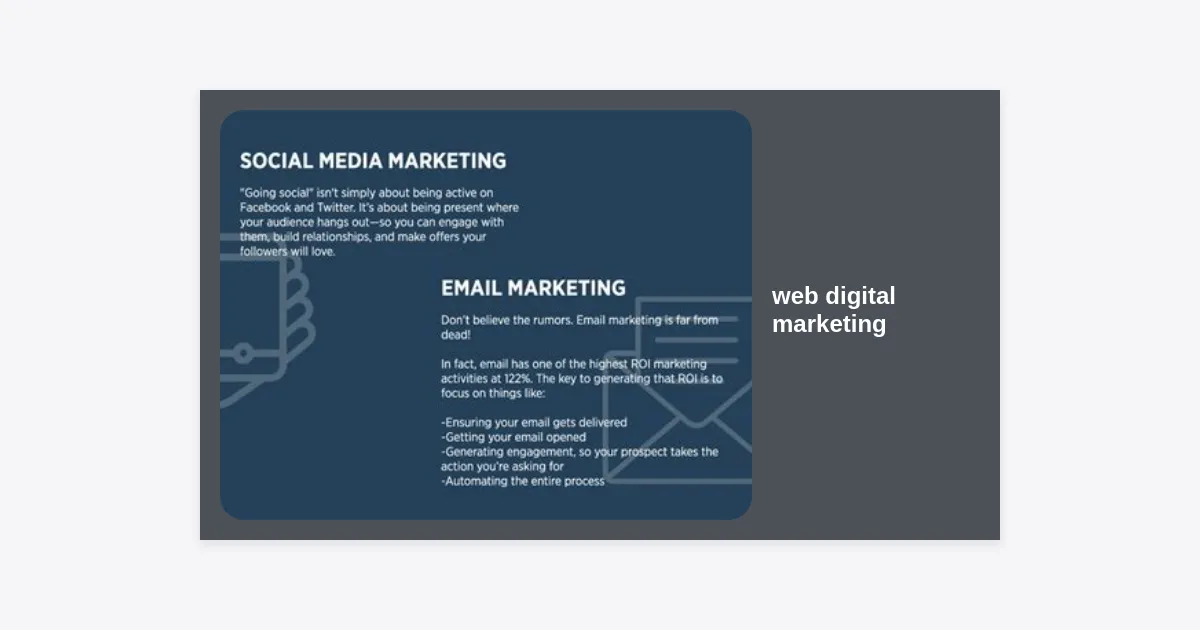
Social media isn’t just for sharing photos; it’s a powerful tool for web digital marketing. Platforms like LinkedIn, Twitter, and TikTok allow brands to engage directly with their customers in real-time.
The secret to social media success is engagement, not just broadcasting. Brands that reply to comments, participate in trends, and share user-generated content (UGC) often see far higher conversion rates than those that only post promotional material.
For B2B companies, LinkedIn is the gold standard for lead generation. For B2C brands, visual platforms like Instagram and TikTok offer unparalleled reach through viral content and influencer partnerships.
7. Email Marketing and Automation
Many believe email is dead, but statistics tell a different story. Email marketing still offers one of the highest returns on investment (ROI) in web digital marketing, with some reports suggesting an average return of $36 for every $1 spent.
The key to modern email marketing is segmentation and automation. Instead of sending the same generic blast to everyone, segment your list based on user behavior (e.g., people who abandoned their cart, or people who recently purchased). Use automated workflows to nurture these leads without manual intervention.
- Welcome Series: Introduce new subscribers to your brand.
- Drip Campaigns: Provide value over time to build interest.
- Re-engagement: Win back customers who haven’t interacted in a while.
8. Measuring Success with Data Analytics
One of the greatest advantages of web digital marketing over traditional methods is the ability to track everything. With tools like Google Analytics 4 (GA4), you can see exactly where your traffic comes from, what they do on your site, and which campaigns are driving sales.
Key Performance Indicators (KPIs) you should monitor include:
- Conversion Rate: The percentage of visitors who complete a desired action.
- Customer Acquisition Cost (CAC): How much it costs to acquire one new customer.
- Bounce Rate: How quickly people leave your site without interacting.
- Click-Through Rate (CTR): The percentage of people who see your ad and click it.
By analyzing this data, you can stop wasting money on underperforming channels and double down on what works. Data-driven decision-making removes the guesswork from your marketing budget.
9. Future Trends in Web Digital Marketing
As we look toward the future, several trends are poised to redefine web digital marketing. Staying ahead of these trends is vital for maintaining a competitive edge.
Artificial Intelligence (AI): From AI-driven chatbots to predictive analytics, AI is making marketing more personalized and efficient. Tools like ChatGPT are already being used to assist in content creation and coding.
Voice Search Optimization: With the rise of smart speakers, more people are searching via voice. This requires a shift toward natural language and conversational keywords.
Video Content dominance: Short-form video is currently the most engaging type of content. Brands that fail to adopt video strategies risk being left behind in the attention economy.
10. Conclusion and Next Steps
Mastering web digital marketing is a journey, not a destination. It requires a commitment to continuous learning, testing, and refinement. By focusing on the core pillars of SEO, content, and data analytics, you can build a robust online presence that drives sustainable growth for your business.
Remember: start small, measure your results, and scale what works. Don’t try to master every platform at once. Instead, master one or two channels where your audience is most active and build from there.
Ready to Scale Your Strategy?
Download our free 2024 Digital Marketing Checklist to ensure you haven’t missed a single step in your growth journey.
Action Plan Summary:
- Audit your website for technical SEO errors.
- Identify the top 5 keywords your target audience is searching for.
- Create a content calendar for the next 30 days.
- Set up basic conversion tracking in GA4.
- Experiment with a small-budget PPC campaign to test your messaging.